


Katherine Hurst reviews new books on wētāpunga (wētā as big as mice!) and the range of insects that call Aotearoa home.
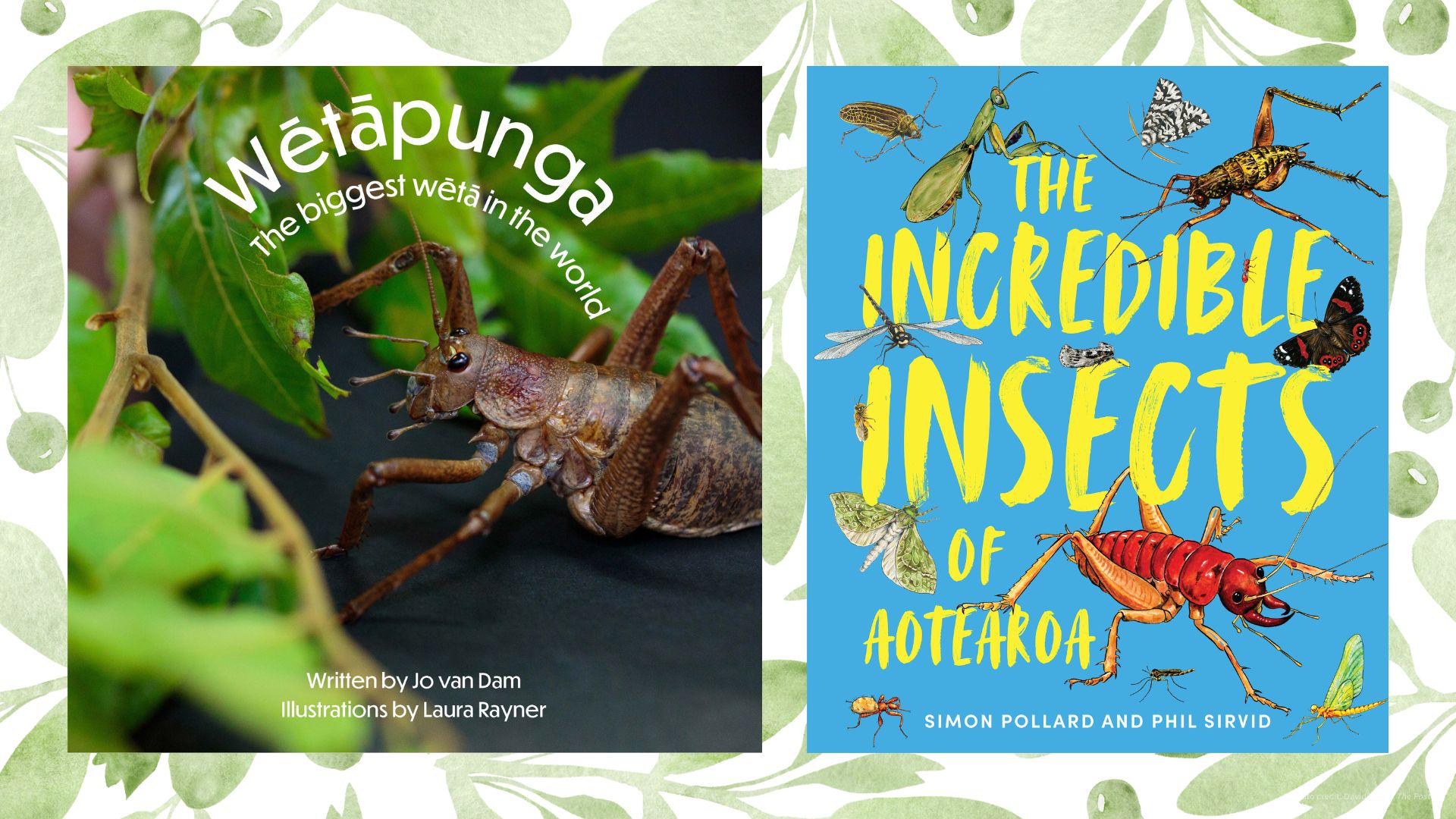
Wētā are famous for being big, and wētāpunga are the biggest of them all—some are heavier than a mouse! Wētāpunga: the biggest wētā in the world tells us all about these extraordinary creatures—their life cycle, how and where they live, and the challenges they face and how we can help them.
Author Jo van Dam explains how she began researching wētā in an attempt to get over her fear of them. Her fascination comes through in this book, supported by cultural guidance from Delma O’Kane of the Ngāti Manuhiri Settlement Trust, and ectotherm expertise from Auckland Zoo’s Don McFarlane. (An ectotherm is a creature that depends on external heat sources to regulate its temperature—all technical terms are explained in the glossary!)
Wētāpunga is a lively and appealing book which packs a surprising amount of information into its engaging text. Like the author, the more I learned about wētāpunga, the more I appreciated them and the more curious I became. The questions I found myself asking (if wētā moult, why don’t we see their old exoskeletons lying around?) were usually answered soon after in the text (they eat them for the nutrients).

There’s some very effective use of language. The section which describes predators eating the wētāpunga builds on each new enemy like a disturbing ‘House that Jack Built’ and is fun (though horrible) to read out loud: ‘The kiore soon roamed free and found that wētāpunga were an easy, tasty (and highly nutritious) meal. The cats and the rats soon ran wild and discovered that wētāpunga were an easy, tasty, crispy meal.’ Sadly, many adjectives are needed for the number of hungry predators.
The author tells us how dire the situation is for the wētāpunga, but focuses on the efforts of the people working to save them, describing successful breeding programmes and transfers to predator-free islands. Books and talks about endangered wildlife often end with some practical suggestions, and here there’s a variety of actions children can take to help wētā species. I liked how she specifically says ‘I know it wasn’t you or me who caused this problem —but we are the ones who can fix it.’

Laura Rayner’s cute black and white illustrations of two young children provide a contrast to the excellent colour photos. The questions and cheeky comments from the two characters will help keep younger readers’ attention through the more information dense sections, though older readers may find the wētā are interesting enough to stand by themselves.
Wētāpunga is both entertaining and informative. Children up to around age 12 will enjoy reading it by themselves, and it would be a great non-fiction choice to read aloud for children as young as preschoolers. Having an entire book dedicated to just one species means that readers will not only learn lots of detailed facts, but also have plenty of time to get attached to these chonky critters.

The Incredible Insects of Aotearoa has a broader focus and introduces the reader to many of the 20,000 species of insects in Aotearoa, but its attractive design and touches of humour ensure that this is much more than a brief ‘Who’s Who’ of the insect world.
Published by Te Papa Press, this fantastic book is brought to you by the same team as Why is That Spider Dancing? The Amazing Arachnids of Aotearoa. Dr Simon Pollard is a spider biologist and Dr Phil Sirvid is Curator of Invertebrates in the Natural History Team at Te Papa.
The cover is instantly appealing with its beautiful art by Lily Duval, and the photos inside show important details explained in the text, as well as being eye-catching—especially the amazing close-ups such as the ‘alien-looking face of a pūriri moth’.
The book begins with an overview of insects in Aotearoa, then a comprehensive guide to insects in general. Useful information is presented clearly alongside diagrams and photos. The book ends with a section on caring for insects, which even includes some practical phone photography tips.

Between these, the bulk of the book is divided into parts for the different environments where you might meet insects—from homes and backyards, to coasts and islands. The authors have selected insects with particularly important, intriguing, or bizarre features or behaviours, and they introduce them to us in stories with titles such as: ‘Deadly jaws at the bottom of the pits of doom’, ‘A jumping wētā and a mountain sorcerer, or ‘How a “skeletoniser” becomes a “mad hatterpillar.”’
Because of this it works really well as a book to dip into, as well as providing the depth of knowledge required for children obsessed with insects. Each insect’s story is fairly short, so if you read one, you might be tempted to keep on going—and suddenly realise you’ve read all 127 pages! The stories are told with plenty of humour, and throw in conservation stories, snippets of history, and entertaining ideas such as ‘the imaginary world of the wētā Olympics’.

The authors worked with Dr Ocean Mercier (Ngāti Porou) to include mātauranga Māori throughout the book. I liked how this was integrated seamlessly throughout the stories, as well as being a focus of some of the earlier sections in the book, such as ‘Insects in te ao Māori’ and ‘Places named after insects’. Readers learn a whakataukī, find out why to pick the kawakawa leaves with the most caterpillar holes for rongoā (medicine), and are told many Māori names for insects, such as the native bee—‘ngaro huruhuru’, meaning furry fly.
Incredible Insects doesn’t just feature the insects. It also includes stories from experts, telling us how insects become such an important part of their lives. Many of the experts talk about their childhoods, normalising a love for bugs from an early age.
This is a great addition to the non-fiction insect books currently available. While it’s never too early to start learning about insects, this book is probably best suited for ages 8 and up—and thanks to the entertaining text, teenagers and adults will also enjoy reading it.
The back cover asks ‘What makes insects in Aotearoa so special?’ Spend some time reading this book and you’ll soon build up a huge list of reasons why our insects are remarkable. You’ll also find out what makes The Incredible Insects of Aotearoa so special—a winning combination of attractive design and photos, amazing insects, and funny and chatty text that makes you want to keep reading.


Katherine Hurst
Katherine Hurst has had a variety of jobs including making superconductors and working in visual effects on The Lord of the Rings movie trilogy. More recently she completed a Master of Science in Society at Victoria University, and now works as a science communicator in Wellington.