


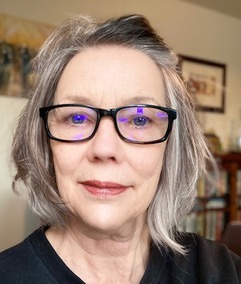
Literacy expert Chris Thornley on how the desire to read must be nurtured by providing learners with books that reflect their cultures, languages and identities
Learning to read is high on the list of expectations for children starting school. Their whānau, teachers and the government all want them to become and remain keen to successfully use reading for learning and pleasure. Beliefs about how they might get there are currently marked by some stark differences. Right now, children must start the journey experiencing the current government’s commitment to phonics (the ability to decode the sounds made by letters in a word).
Problem One
Preliminary results from phonics testing indicate improvements attributed to the programme, and have been touted by Minister of Education Erica Stanford as indicative of accelerated reading achievement. But recently the minister was alerted to a potential ‘fly in the ointment’—te reo words that did not fit the ‘sounding out’ pattern demanded for the prescribed phonics learning progression. Her simple fix was to remove those words and to set a limit on the number of te reo words that can be in the phonics programme books.
Her simple fix was to remove those words and to set a limit on the number of te reo words that can be in the phonics programme books
This is highly problematic. It automatically reduces the topics that children can experience in their first foray into learning to read at school. If the word ‘marae’ is not allowed, how can there be a story about the joy of being there? How can there be a story about ‘whānau’ or ‘fishing’, even, if characters catch a ‘kōura’ or ‘tuna’? How can there be stories about kapa haka, or Matariki in their lives? Quite simply the books our youngest learners will encounter in their reading instruction will have stories set in contexts that are Pākehā orientated. Amongst these books there will be nothing that reflects the rich tapestry of our individual and collective cultures, identities and languages here in Aotearoa New Zealand.
There is no argument about the importance of children knowing the sounds letters make. Phonics is an important aspect of reading, but it cannot take precedence over all else, when it’s simply one cognitive skill. Learning to read independently is a complex task of drawing on experience and knowledge, inferring from print and visual information, while cross-checking for accuracy. This all requires high levels of interest, and motivation.
Problem Two
The Government then saw a problem in the requirement that Boards of Trustees ensure their schools give effect to te Tiriti o Waitangi. The Government said there was no evidence that this improved achievement, so the solution was to remove it. But te Tiriti is the foundation from which we honour the language, culture and identity of all who live in our country, so that’s all children in all our schools. It recognises that this is the only place in the world where Māori are tangata whenua. It is also the only place where non-Māori are tangata Tiriti (people of the Tiriti). We all belong here, and our children should all feel like they belong in our schools learning about their own and each other’s cultures, none better or less worthy than the other.
Both quick fix solutions present us as whānau, parents, librarians and teachers with risks. Fortunately, we have a solution to mitigate these.
Solution for parents, whānau, librarians and teachers
This solution has only evolved in recent years through the success of New Zealand authors, illustrators, translators and publishers in creating a vast array of picture books, perfect for sharing with children across the early years of school. Books that illustrate how we have moved from last century when diversity in stories was scarce, and people and cultures other than Pākehā were largely rendered invisible.
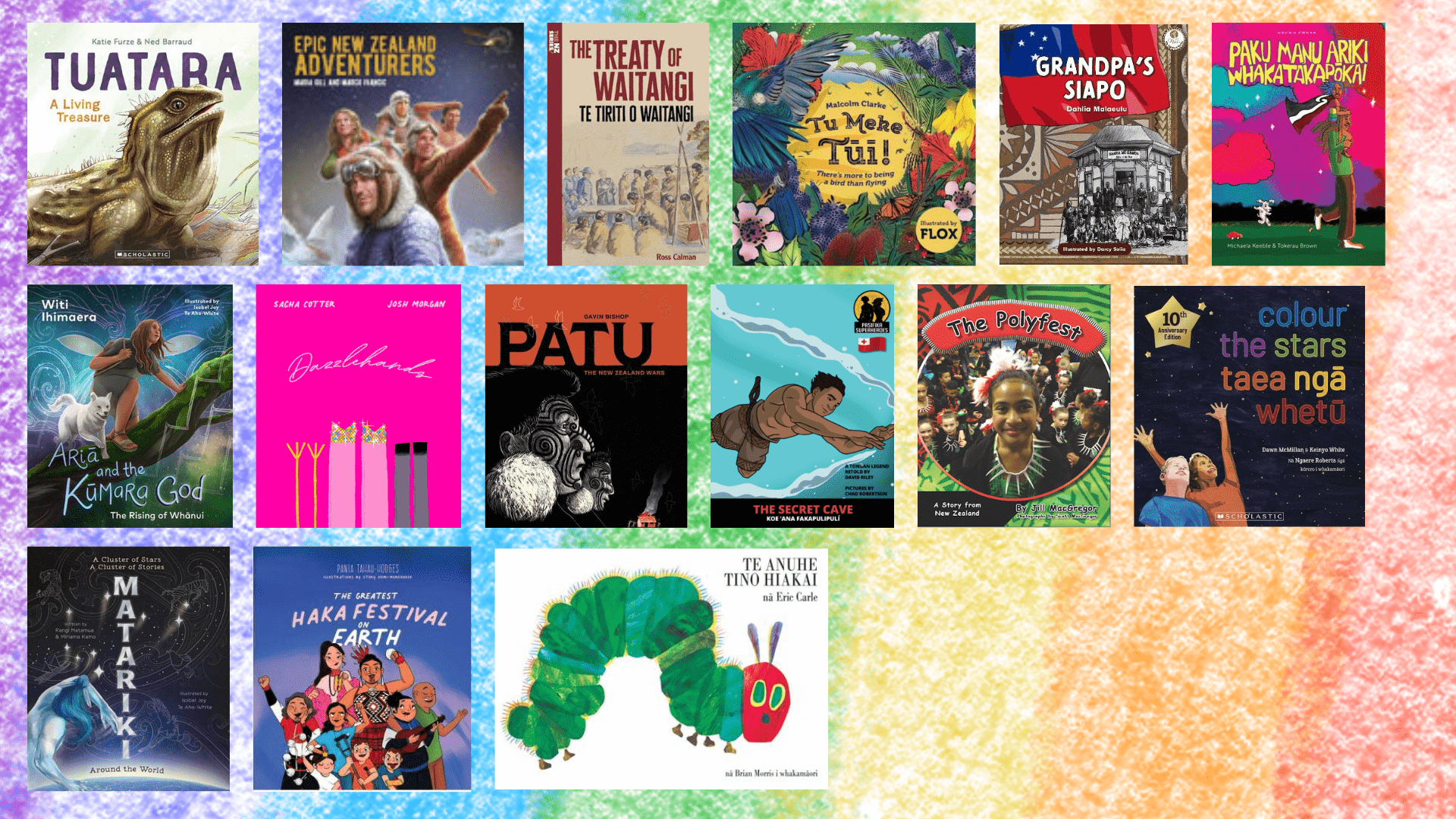
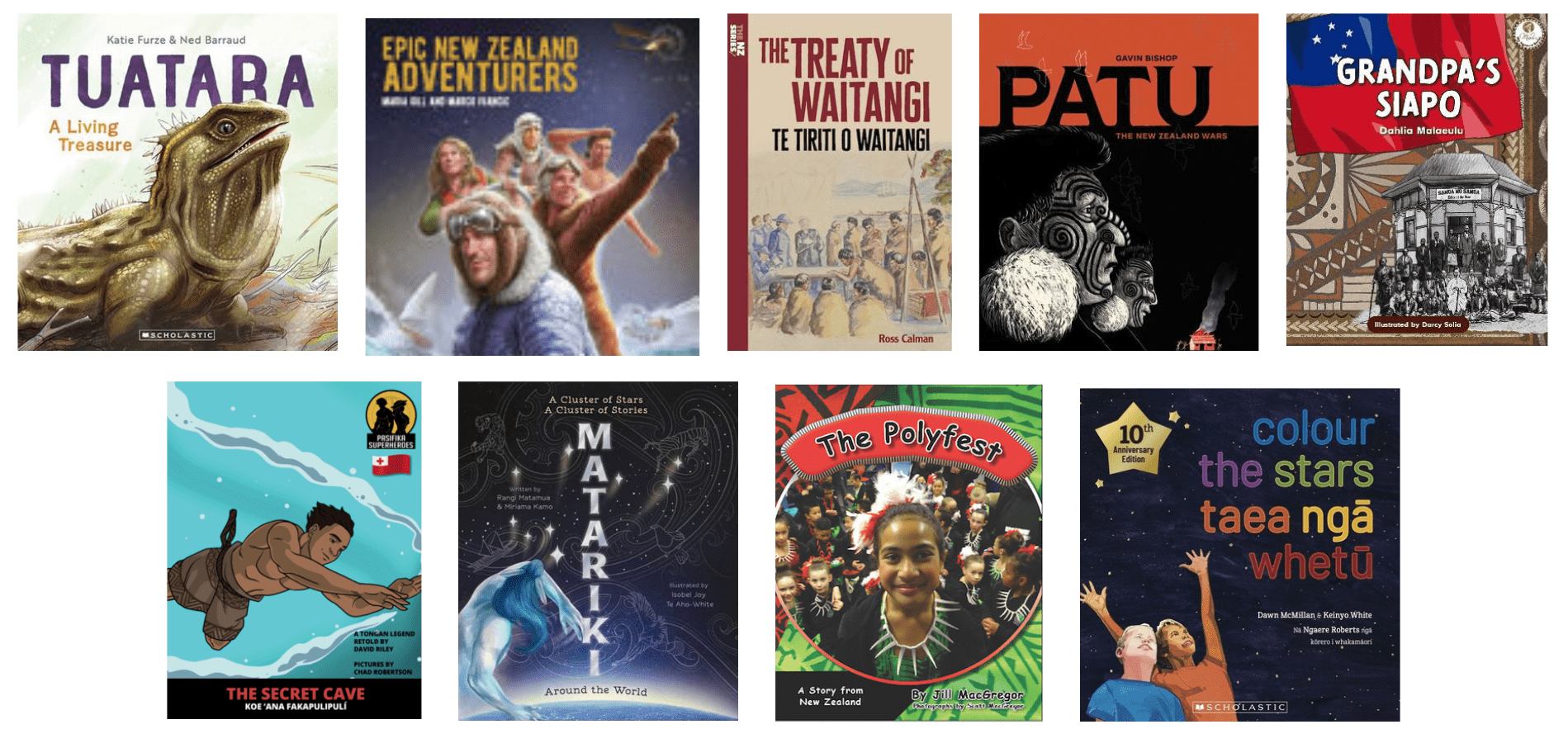
Let’s consider a few of these stories. Firstly, some that challenge the perception of ‘Pākehā as the norm’ here; Pākehā whose activities and ways of being are so pervasive as to create a pseudo benchmark. But what fun to read about the adventure of participation in The Greatest Haka Festival on Earth, or The Polyfest or enjoy the pūrākau of Ariā and the Kūmara God. In non-fiction, children can engage with Epic New Zealand Adventurers, who are both tangata Tiriti and tangata whenua living and travelling fearlessly around the world.
Everyone deserves to understand their valued place in their community, school and indeed the world. This strengthens their sense of identity and belonging. Matariki: A Cluster of Stars, a Cluster of Stories is perfect in this regard as the reader learns not only about Matariki here, but celebrations associated with this constellation across the globe. Again, The Treaty of Waitangi: Te Tiriti o Waitangi talks about the waves of people coming here for a better life, not fully leaving their old lives behind but seeing how those ways of knowing and being inform their lives here with te Tiriti as our foundation—like the Tongan folktale The Secret Cave Koe ‘Ana Fakapulipulí.
… you can be assured te reo texts belong. It is an official language, unique to this country and therefore of significance to all our children
Paku Manu Airki Whakatakapokai, Grandpa’s Siapo and Patu are all books that would be suitable for older children but also suit the under twelves. And each in their own way help to build understandings of the past, present and future touching topics like colonisation, sovereignty, and if we include Tuatara: A Lving Treasure, the environment.
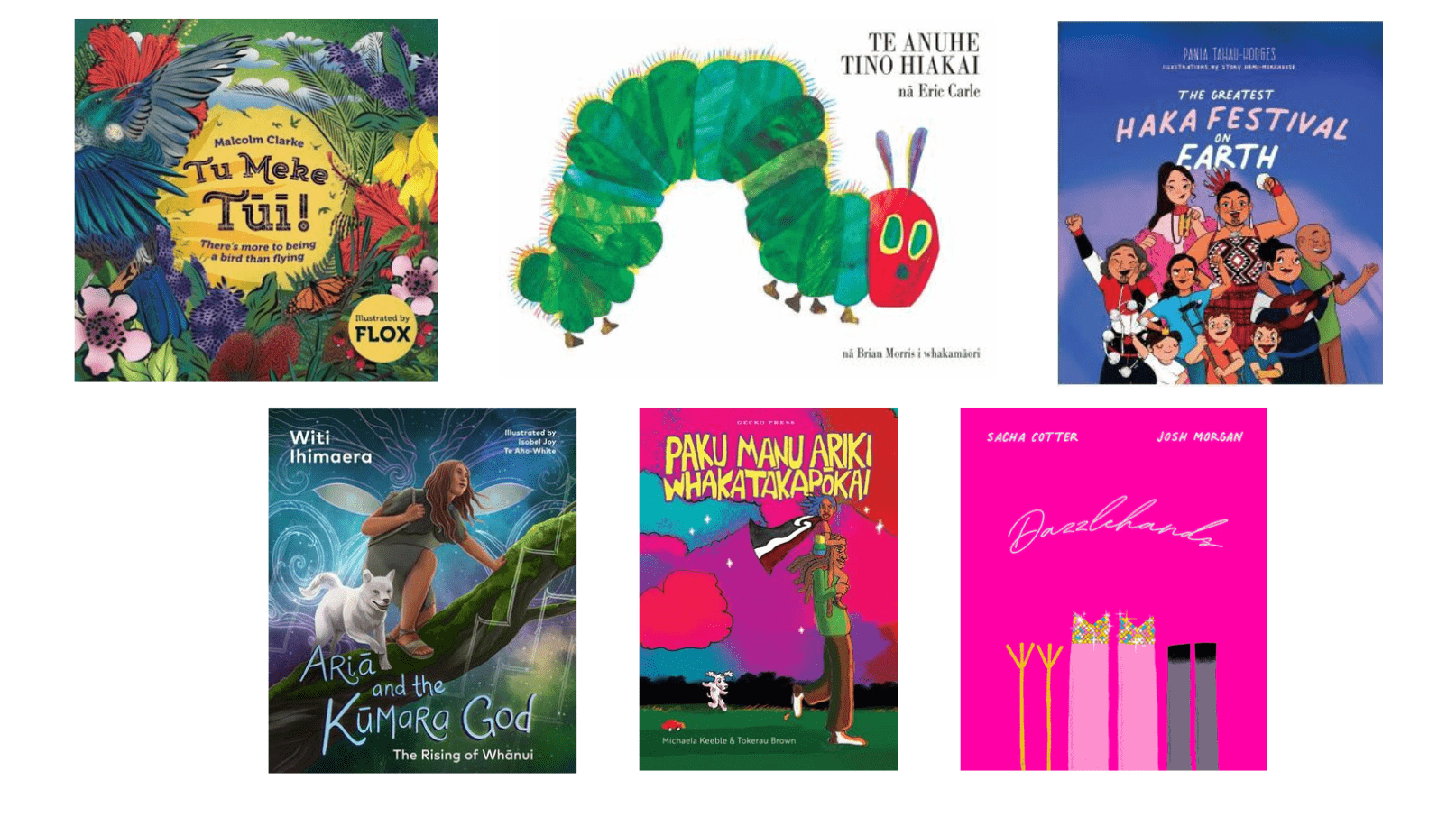
Dazzlehands and Tu Meke Tūī convey to their readers that everyone is important and offer the courage to challenge stereotypes and misrepresentations, helping children to see they are all worthy.
Decisions about whether te reo texts should rightfully challenge the supremacy of English in homes, libraries and schools, can be made using these simple questions. ‘Do the children I read to and with speak te reo?’, ‘Are they Māori?’, ‘Do they live in New Zealand?’ If you answer yes to any of these, you can be assured te reo texts belong. It is an official language, unique to this country and therefore of significance to all our children. You may not understand all the words but together you can be learning to pronounce them. There are now books in different language configurations like Te Anuhe Tino Hiakai, Tu Meke Tūī, Colour the Stars/Taea Ngā Whetu all of which can foster language curiosity and the readers’ strength of identity. Seeing te reo as ‘the language of my people’ or ‘a language of my country’ are both perceptions to be gained from these books.
Let’s keep children at the forefront of literacy learning, let’s not go back to last century and let’s not forget reading is not always easy. Let’s remember keeping children’ s motivation for learning to read high by honouring culture, identity and language through picture books is more achievable now than ever before.
Book List
Bishop, G. (2023). Patu: The New Zealand Wars. Penguin Random House NZ.
Calman, R. (2023). The Treaty of Waitangi: Te Tiriti o Waitangi. Oratia Publishing.
Carle, E. (2012). Te Anuhe Tino Hiakai (B. Morris, Trans). Huia. (Original work published 1987).
Clarke, M. (2019). Tu Meke Tūī!: There’s More to Being a Bird than Flying. Mary Egan Publishing.
Cotter, S. & Morgan, J. (2023). Dazzlehands. Huia.
Furze, K. & Barraud, N. (2023). Tuatara: A Living Treasure. Scholastic.
Gill, M. & Ivancic, M. (2023). Epic New Zealand Adventurers. Upstart Press.
Tahau-Hodges, P. (2021). The Greatest Haka Festival on Earth. Huia.
Ihimaera, W. (2024). Ariā and the Kūmara God: The Rising of Whānui. Penguin Random House NZ.
Keeble, M. & Brown T. (2023). Paku Manu Ariki Whakatakapokai. Gecko Press.
MacGregor, J. (2019). The Polyfest: A Story from New Zealand. Puriri Paddocks.
Malaeulu, D. (2022). Grandpa’s Siapo. Mila’s Books
McMillan, D. & White, K. Colour the Stars/Taea Ngā Whetū (N. Roberts, Trans). Scholastic.
Matamua, R. & Kamo, M. (2022). Matariki: A Cluster of Stars, a Cluster of Stories. Scholastic.
Riley, D. (2022). The Secret Cave: Koe ‘ana Fakapulipulí (Tongan legend retold, D. Riley) Reading Warrior.

Chris Thornley
Chris Thornley has been a teacher, literacy researcher, and professional development facilitator across primary, secondary, and tertiary education here and in the United States. She has also facilitated Our Code Ngā Tikanga Matatika workshops and was involved in the development of the Teaching Council’s Unteach Racism resource. She is Tangata Tiriti (non-Māori).