


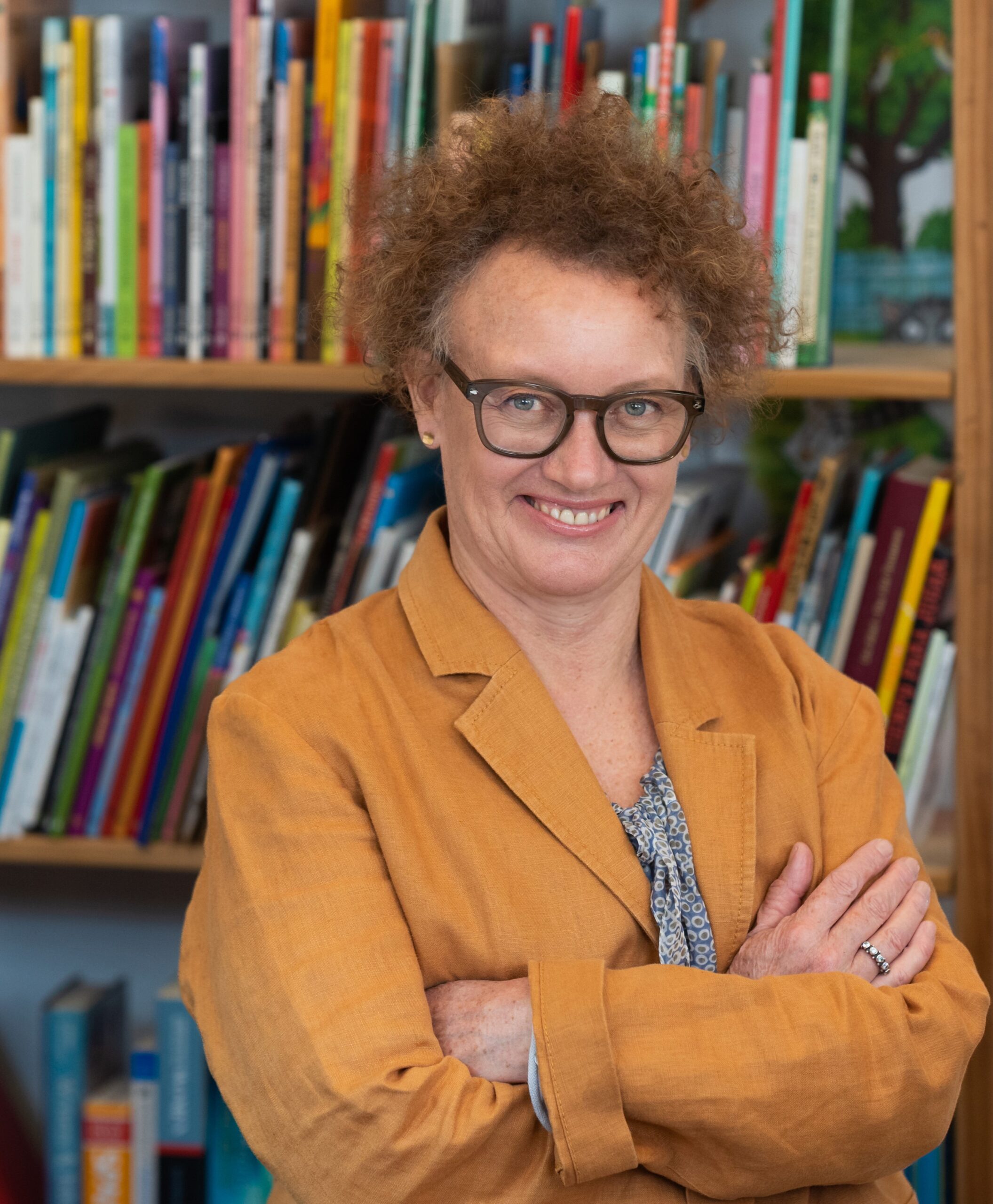
Writer Anders Sparring and illustrator/writer Per Gustavsson performed to more than 1000 children at the 2025 Auckland Writers Festival. They are the Swedish creators of The Pinchers, a junior chapter book series based on a family of criminals.
Julia Marshall, translator of three Pincher titles into English, talks to them about writing a series, what makes them funny, and how they came to write books for children.
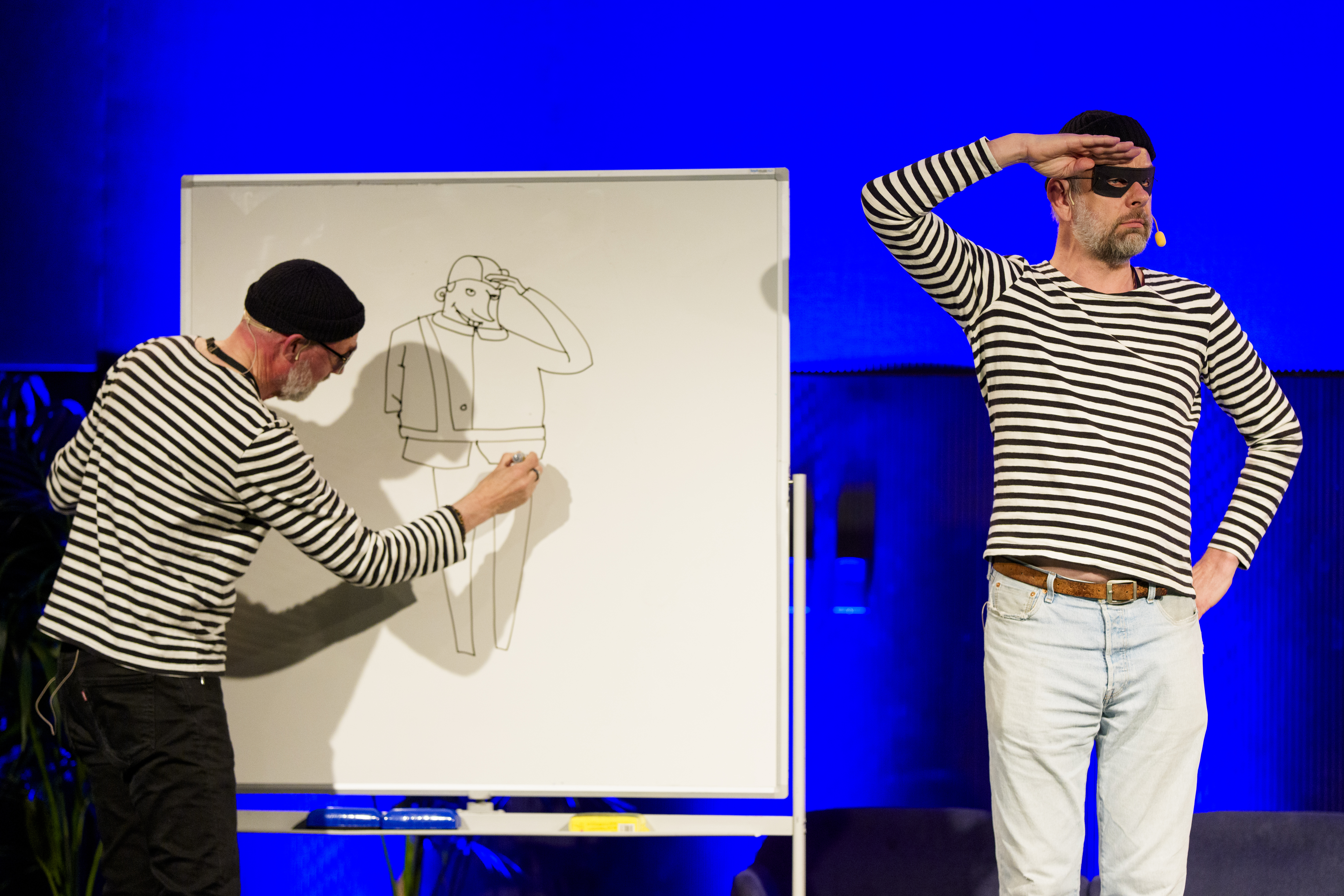
Anders Sparring (born 1969) and Per Gustavsson (1962), first met on stage. Sparring was interviewing Gustavsson at a publisher’s ‘Meet the Authors’ event. They were both funny.
When the publisher asked Per (pronounced ‘pear’) what writer he’d like to work with on a new chapter series for children, he said, ‘I’d like to work with that funny guy, Anders’ (pronounced ‘Andersh’).
Five minutes into a brainstorm session with their editor, they noted that books with children solving crimes were very popular at the time in Sweden. ‘But it was so mechanical,’ says Sparring.
‘So instead, we invented a family as a bunch of thieves. Then we thought of terrible things for them to do, it was quite funny. But when we went back to it, we found many of the ideas were unsuitable for children. So, we came up with the idea of the criminal family who steal each other’s socks. They all wear striped shirts and robber masks; and then we came up with Theo, the robber-child who cannot tell a lie.’
The character of Theo provides a necessary tension. His mother, Nic, despairs that Theo will never get anywhere in life if he doesn’t learn to lie.
The names of all the Pincher (Knyckertz, in Swedish) characters except Theo, relate to thieving. Gustavsson’s favourite character is Theo’s father, Rob. ‘He’s big and boisterous and has a big heart. He carries a crowbar. The mother, Nic, is my least favourite character. She makes the rules.’
Sparring identifies with Theo. ‘I am Theo,’ he says. But he likes Ellen, short for Criminellen, because she always says yes.
But the family of thieves is a warm, caring family. ‘They look after each other,’ says Gustavsson. The children have to brush their teeth and eat breakfast. They make toast in the new toaster Mama Nic came home with under her coat just last week. In a scene in The Pinchers and the Diamond Heist, they visit Grandma Stola in jail, so Ellen can have her goodnight story read to her properly by an adult.
‘You can tell they like each other,’ says Sparring. ‘That’s important.’
The Pincher stories are full of slapstick humour, upside-downities, puns and one-liners. But the characters are recognisable and real. As Gustavsson says, ‘we want to squeeze their hearts a bit’. He’s talking about the readers, often referred to by Gustavsson and Sparring as ‘the audience’.
Sparring is a stand-up comedian in his spare time. It’s another form of storytelling, he says. ‘I’m not good at it but I do it. It’s a good way to learn how to get stories running. You need to get to the point.’
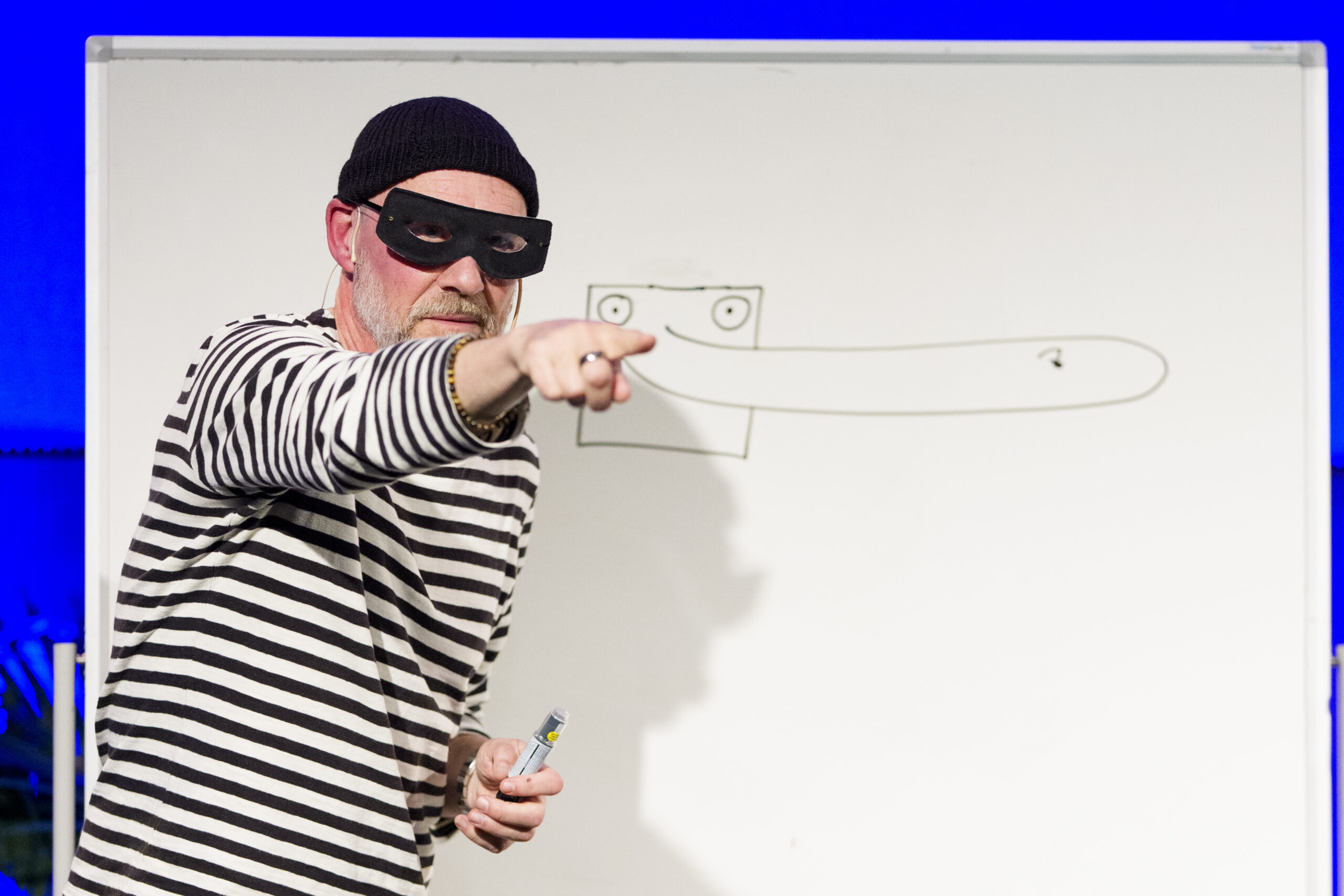
When they perform to children, Gustavsson has his whiteboard at the ready, and Sparring launches into a string of incongruities, both working quick-fire with the audience.
Gustavsson came to children’s books as an illustrator. At 14, he tried drawing to impress a girl who was very good at it. She was unimpressed, but he didn’t stop; he bought some paints and went on to art school. ‘But I found it quite boring to stand and paint, just so your friends could come and look and have an opinion, so I switched my course to illustration.’
The Pincher stories are full of slapstick humour, upside-downities, puns and one-liners
In the eighties, with the revival of comics, he began making one-page comic strips with a punchline. ‘And I discovered I had stories in me too. I entered a competition that I didn’t win, but Raben & Sjögren published my book Stoppa Bollen (Stop the Ball) anyway. That’s how I started doing picture books.’
He went on to illustrate other writer’s texts—Ulf Stark, Barbro Lindgren and Åsa Lind—but his breakthrough came with a still-in-print series of picture books about an outspoken princess, published in 2003 and republished in 2024; he is a little tired now of drawing princesses.
He draws first with pencil and then works digitally. He doesn’t like his colours to be too loud. His illustrations are emotional, a lot of character and feeling in a few lines, to balance and expand the text.
Sparring came to writing via television. He wanted to be an actor, so trained as a TV producer and then worked as a script writer for children’s TV—’factual programmes, which I didn’t take to.’
Then he found a copy of Three Friends and … Jerry in a friend’s bookshelf and asked if he could write a test script. At the age of ‘around 29’, he was employed as head writer for the series. Since then, he has written award-winning screenplays for many popular television shows including An Honest Christmas with the Knyckertz, based on the books about the Pincher family.
He says his path to children’s writing was simple. ‘I realised when I started writing scripts that I was pretty good. Then I was on parental leave with my second child who slept all the time, so I wrote a series that took seven years to get published.’
Sparring and Gustavsson are a partnership, a twosome. ‘We hang out together, we work together. It’s a collaboration,’ says Sparring. ‘We do ideas together.’
‘Humour has to be about something that means something to the audience,’ says Gustavsson. ‘Joking is a way to get close to people and it’s a defence; so people don’t hit you.’
‘You need a good story, cliffhangers, and the level of humour needs to be very high,’ says Sparring. ‘Character is key—I have to get to know the characters.’
They like plenty of time to work. After they’ve discussed an idea for their next Pincher book, Sparring writes a draft synopsis, ‘with a beginning, a middle and an end.’
Then he begins a detailed synopsis of the whole book: about halfway through, he stops.
‘By then I know the characters, and what’s possible, so I can outline the chapters. Then I write the chapters. It’s the same way I do a television series. Once I know the pace, that helps the decision making.’
He can write ‘quite well’ under pressure but cannot start under pressure. ‘I need quiet to start and then once the machine is going, it’s easier.’
He writes slowly. He sends a chapter to Per, who sends some pictures back. That encourages him to write the next chapter. His job is to be ahead of the illustrations, but Gustavsson is quicker than Sparring—true in most things, Gustavsson says.
‘If I write more than one chapter a day,’ says Sparring, ‘I can’t make the right decisions. Ideally the writing makes the decisions for you. I like to get each chapter perfect before I move on. I am an extreme perfectionist, I move commas.’He thinks his workday is probably normal for most writers: ‘I read and rewrite what I wrote yesterday. I try to write one chapter a day, but I’ve learnt one thing that works really well: I don’t finish my day with the end of the chapter; I start the next three sentences.’
Joking is a way to get close to people and it’s a defence; so people don’t hit you.
‘We influence each other,’ says Gustavsson. ‘I can add things, or sometimes I say that doesn’t feel right, she wouldn’t do that. Sometimes I send a picture to Anders, and he might take it or not. I might do a layout to see what works. Sometimes Anders says this piece is hard to write, it’d be better if you do a comic.’
Sometimes Sparring rings to read a chapter aloud. ‘I might say: “That’s good, can you push that a bit more, I want to feel that more.” But quite often he’s laughing so hard I don’t know if it’s funny or not.’
They talk about John Cleese’s legendary 1991 Speech About Creativity, where Cleese lists the five necessary factors: Space, Time, Time, Confidence and Humour. But the necessary slow pace of writing well does not always fit in with a publishing cycle, so they think it could be best to get everything done before they pitch a story to their publishers.
Worst, says Gustavsson, is being asked for a cover before a book has been finished. And then a new cover once it is finished.
Sparring always reads his work out loud, to get into the shoes of the parents reading as well as the children reading on their own.
‘My parents read out loud to me; Jack London, and Alistair MacLean, Tove Jansson.’
‘I think parents should practice reading aloud. When I was working at a daycare centre I was taught to read upside down,’ says Anders. ‘My parents were really good at reading aloud.’
Gustavsson read Lucky Luke, the man who drove faster than his shadow, and Tintin. And he was allowed to borrow The Exorcist, though the librarian asked if it was all right with his parents. ‘It wasn’t worse than what was already inside my head,’ he says.
‘I don’t make pictures only for children, I do them for me. I did a book called Pojken, pappan och björnen (The boy, the father and the bear) and I got a review that said: “This book is for people. Some of them are small”. And I cried.’
Their advice to young writers or old: Per suggests you try to tell a short story with a beginning, middle and an end. Anders is adamant that you ‘throw away the eraser. Don’t rub anything out, if you start rubbing things out you might never get to the end, and you’ll probably lose all the best bits along the way. Throw the eraser away!’
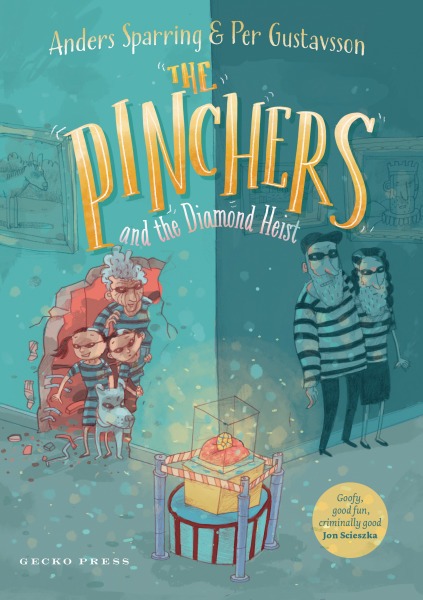
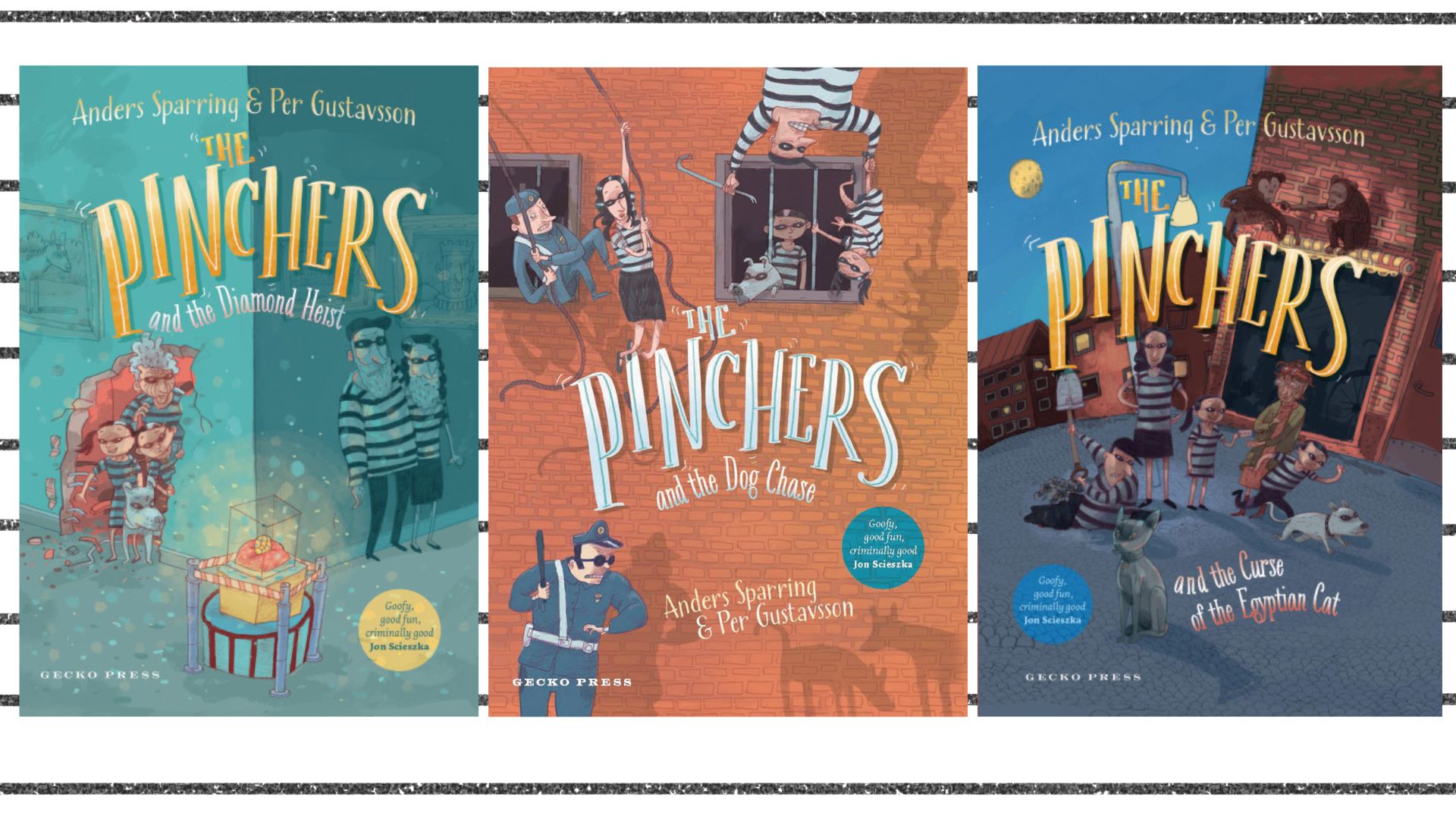
The Pinchers and the Diamond Heist
Anders Sparring and Per Gustavsson
Gecko Press
$19.99
Buy now
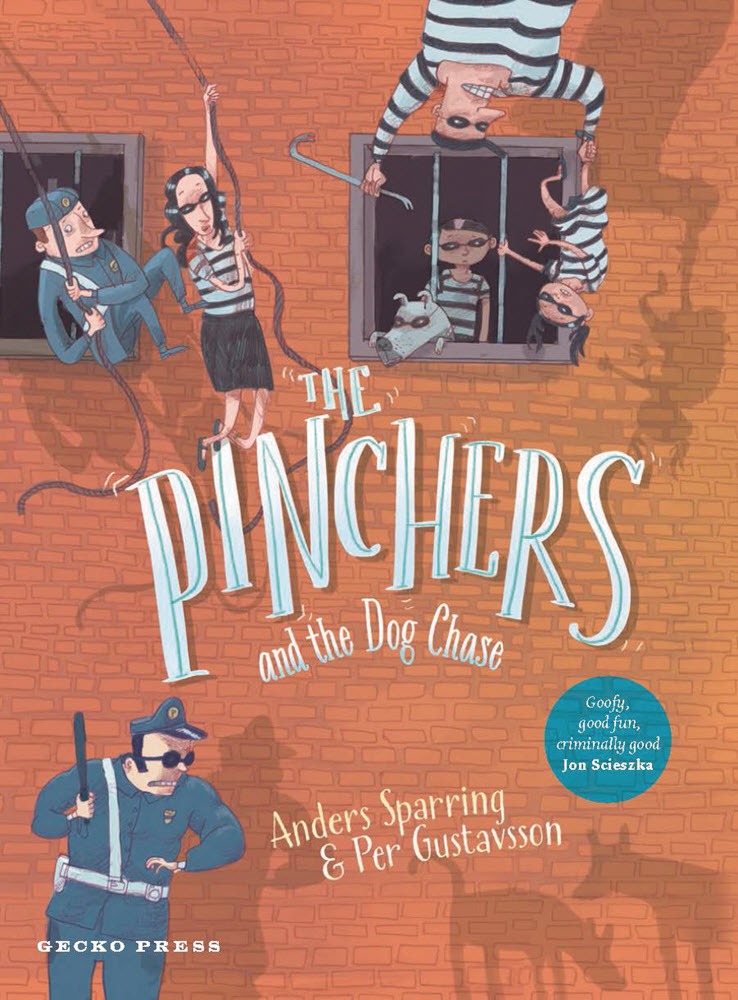
The Pinchers and the Dog Chase
Anders Sparring and Per Gustavsson
Gecko Press
$19.99
Buy now
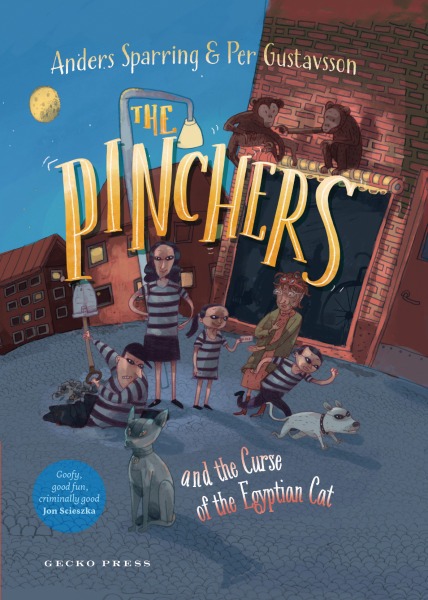
The Pinchers and the Curse of the Egyptian Cat
Anders Sparring and Per Gustavsson
Gecko Press
$19.99
Buy now

Julia Marshall
Julia Marshall is the founder of Gecko Press, publishers of curiously good children’s books from around the world. She worked as publisher, translator from Swedish, picture book editor and CEO from 2004 to 2023. Julia was President of PANZ (Publishers Association New Zealand) and a Board Member for Read New Zealand. She believes all children have the right to love to read. She now provides freelance services through her company, Spotted Dotterel.